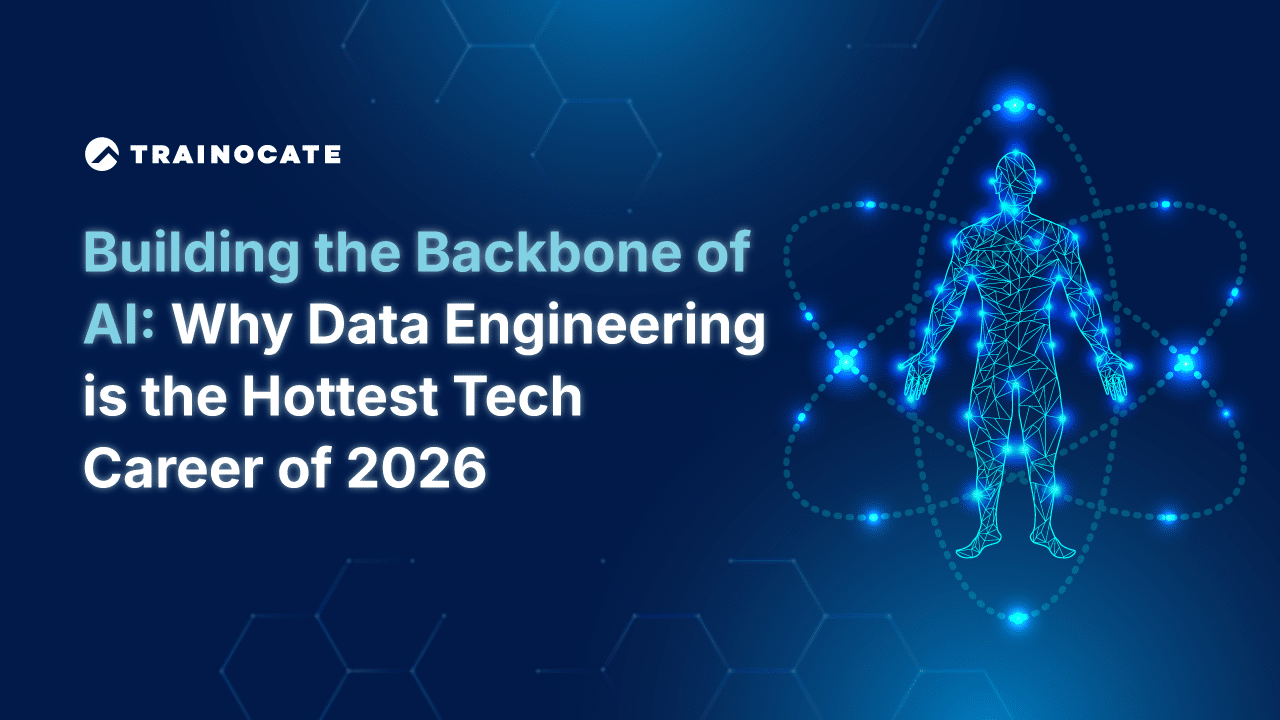
Building the Backbone of AI: Why Data Engineering is the Hottest Tech Career of 2026
Building the Backbone of AI: Why Data Engineering is the Hottest Tech Career of 2026
In the race to dominate the AI-powered future, companies are investing billions in advanced algorithms and brilliant data scientists.
Yet, a surprising and critical bottleneck is emerging.
39% of respondents state that data issues is the top challenge in scaling Gen AI and a staggering 52% of organizations admit their data foundation is inadequate for Generative AI
Source: Scaling Generative AI for Value: Data Leader Agenda for 2025
This is the “data readiness gap,” and it’s the single biggest reason AI projects fail to deliver value.
Enter the Data Engineer – the architect and builder of the modern data-driven enterprise. While data scientists and AI specialists often get the spotlight, data engineers are the unsung heroes working behind the scenes.
They design, build, and maintain the robust infrastructure that collects, stores, and transports high-quality data. Without their work, there is no data analytics, no machine learning, and no AI.
As we look to 2026, the demand for skilled data engineers in Malaysia is exploding. They are the essential enablers of the AI revolution, making this one of the most secure, in-demand, and lucrative career paths in technology today.
This article explores the essential skills you need to become a data engineer and build the very backbone of AI, and continues from our Ultimate Guide to the Top Data and AI Skills for 2026 post.
What is the Cloud Data Stack and Why Must You Master It?
In 2026, data engineering is fundamentally about the cloud.
The sheer volume, velocity, and variety of data required for modern AI have made on-premise data centers obsolete for all but the most niche use cases. Companies are building their data infrastructure on the world’s major cloud platforms, and they need engineers who are fluent in their specific ecosystems.
Mastering the data stack of at least one of the “big three” cloud providers is no longer optional; it is the price of entry for a data engineering career.

As the market leader in cloud infrastructure, AWS offers a mature and comprehensive suite of data services.
Data engineers on AWS are expected to be proficient with services like Amazon S3 (for object storage), AWS Glue (for ETL), Amazon Redshift (for data warehousing), and Amazon Kinesis (for real-time data streaming).

With massive investments in Malaysia, Azure is a dominant force in the enterprise space.
Azure data engineers work with tools like Azure Data Lake Storage, Azure Data Factory (for data integration), Azure Synapse Analytics (for unified analytics), and Azure Databricks.

Known for its deep roots in data and AI, Google Cloud is another major player.
Key services for data engineers include Google Cloud Storage, BigQuery (its serverless data warehouse), and Dataflow (for stream and batch data processing).
Proficiency in one of these platforms is essential, and familiarity with others demonstrates valuable cross-platform flexibility that employers highly covet.
How are Modern Data Warehouses and Lakehouses Changing the Game?
For decades, the “data warehouse” was the standard for storing structured business data. However, the age of AI requires a more flexible approach that can handle structured, semi-structured, and unstructured data (like text, images, and videos) at a massive scale.
This has led to the rise of two transformative technologies: the cloud data warehouse and the data lakehouse.
These modern platforms have become industry standards, and expertise in them is a major differentiator for any data engineer in 2026.
What Does it Take to Build Robust Data Pipelines?
At its core, data engineering is about movement: moving data from its source to a destination where it can be used for analysis.
This process is managed through data pipelines. A data engineer’s primary responsibility is to design, build, and maintain these pipelines, ensuring that data flows reliably, efficiently, and securely.
This involves mastering the concepts of ETL (Extract, Transform, Load) and ELT (Extract, Load, Transform), the two primary methods for processing data. Key technologies and skills in this area include:

Big Data Processing Frameworks
For handling massive datasets that cannot be processed on a single machine, expertise in distributed computing frameworks is essential. Apache Spark is the de facto industry standard for large-scale data processing, and knowledge of its predecessor, Apache Hadoop, is also valuable.

Workflow Orchestration
Data pipelines are often complex workflows with multiple steps and dependencies.
Tools such as Apache Airflow are used to schedule, monitor, and manage these workflows, ensuring that jobs run in the correct order and that failures are handled gracefully.

Programming and SQL
Strong programming skills, particularly in Python and SQL, are the foundational tools for building data pipelines.
Python is used for scripting and automation, while SQL is used for querying and transforming data within databases and data warehouses.
Which Data Engineering Certifications Do Employers Actually Demand in 2026?
While hands-on experience is paramount, professional certifications are the most effective way to validate your skills on specific platforms and signal your expertise to employers in Malaysia.
The consensus among hiring managers and practicing engineers is clear: vendor-specific certifications from the major cloud and data platforms hold the most weight.
For any aspiring data engineer, these are the credentials to target for 2026: