The New Leadership Playbook: 4 Strategic AI Skills Every Manager Needs in 2026
The New Leadership Playbook: 4 Strategic AI Skills Every Manager Needs in 2026
For the past few years, the conversation around Artificial Intelligence has been dominated by technical skills such as coding, algorithms, and data infrastructure. But as we enter 2026, a profound shift is underway.
The next wave of productivity and competitive advantage will not come from simply using AI, but from leading it. The most effective leaders will be those who can orchestrate a new kind of workforce, blending human talent with intelligent, autonomous systems.
This is the dawn of the Agentic Era, a term coined by global thought leaders such as McKinsey and Gartner to describe a paradigm where AI evolves from a passive tool into a proactive collaborator.
These “AI agents” are autonomous systems that can understand high-level goals, formulate plans, and execute complex, multi-step tasks with minimal human intervention.
This transformation demands a new playbook for business leaders, managers, and non-technical executives. The most crucial skills for 2026 are not about writing code; they are about strategy, governance, and communication.
This article is part 4 of the Ultimate Guide to the Top Data and AI Skills for 2026 series and breaks down the four essential strategic AI skills every leader needs to master to navigate this new frontier.
How Will You Manage a Hybrid Human-AI Workforce?
The role of a manager has always been about delegating tasks to achieve a team’s objectives. In 2026, your team is expanding to include digital members. The first critical skill is learning to manage this hybrid workforce.
This goes far beyond using a chatbot. It involves AI Agent Management, a new leadership competency focused on directing autonomous AI systems.
Microsoft’s 2025 Work Trend Index identifies the rise of the “agent boss”—a manager who strategically builds, delegates to, and oversees AI agents to amplify their team’s output.
Mastering this skill involves:

Strategic Delegation
Identifying complex, end-to-end workflows (like market research, lead qualification, or logistics coordination) that can be assigned to an AI agent.

Defining Clear Objectives
Learning to communicate high-level goals and constraints to an AI system, rather than providing step-by-step instructions.

Oversight and Quality Control
Establishing processes to review, validate, and refine the outputs of autonomous agents to ensure they meet business standards.

Fostering Collaboration
Designing new workflows where human team members and AI agents collaborate seamlessly, with each focusing on what they do best.
Accenture’s research underscores this shift, with 77% of executives agreeing that AI agents will fundamentally reinvent how their organizations build and operate digital systems.
Leaders who master agent management will unlock unprecedented levels of productivity and scale.
How Can You Communicate Strategically with AI?
As AI becomes more capable, the quality of your output is directly proportional to the quality of your input.
Advanced Prompt Engineering is the skill of communicating with AI with precision, context, and strategic intent.
For leaders, this is not a technical task but a core communication competency.
It’s the difference between asking a simple question and crafting a detailed directive that guides an AI to produce a nuanced, business-ready result. Think of it as writing a creative brief for a highly intelligent but inexperienced team member.
Strategic prompt engineering for business includes:
Mastering this skill allows leaders to leverage AI for high-value tasks like drafting strategic plans, analyzing competitor reports, and generating creative marketing campaigns, turning generative AI from a novelty into a powerful strategic partner.
How Will You Build and Maintain Trust in AI?
As AI systems become more autonomous and integrated into critical business functions, trust becomes the ultimate gatekeeper to adoption.
The number of publicly reported AI-related incidents, such as those involving bias or misinformation, is rising sharply. Consequently, AI Governance and Responsible AI has evolved from an ethical ideal into a non-negotiable business and compliance imperative.
Leaders in 2026 must be able to champion and implement a framework for responsible AI. This is not just an IT or legal issue; it is a core component of corporate governance.
Key pillars of this skill include:

Understanding and Mitigating Bias
Recognizing that AI models can perpetuate and even amplify human biases present in their training data, and implementing processes to audit and correct for this.

Ensuring Transparency and Explainability
Demanding that AI systems are not “black boxes.” Leaders must be able to explain, at a high level, how an AI model arrived at a particular decision, especially in sensitive areas like hiring or credit scoring.

Navigating the Regulatory Landscape
Staying informed about the evolving global and local regulations.
In Malaysia, the National AI Office (NAIO) is actively developing an “AI Adoption Regulatory Framework” and a national “AI Code of Ethics” to guide responsible development.
Leaders must ensure their organization’s practices align with these emerging standards.

Implementing Governance Platforms
Championing the adoption of tools and platforms that help manage, monitor, and enforce AI policies across the organization, a trend Gartner has identified as critical for 2025 and beyond in their Top 10 Strategic Technology Trends for 2025 report.
How Can You Prepare Your Entire Organization for the AI Shift?
The successful adoption of AI is as much a cultural challenge as it is a technical one. A significant perception gap often exists within organizations.
Leaders anticipate that within five years, teams will be regularly training and managing AI agents as part of their responsibilities.
While 79% of leadersbelieve AI will accelerate their careers, only 67% of employees share that optimism (Source: Microsoft 2025 Work Trend Index report).
This highlights underlying anxieties about job security and the changing nature of work.
The final strategic skill is Fostering AI Literacy across the entire organization. It is the leader’s responsibility to demystify AI, build confidence, and create a culture of enthusiastic and responsible adoption.
This is particularly crucial in Malaysia, where a 2025 Hays report found that while 56% of professionals use AI tools at work, only 26% have received formal training.
Strategies for fostering AI literacy include:
Mastering this skill allows leaders to leverage AI for high-value tasks like drafting strategic plans, analyzing competitor reports, and generating creative marketing campaigns, turning generative AI from a novelty into a powerful strategic partner.
Upcoming Free Virtual Event: Building Autonomous AI Agents with AWS
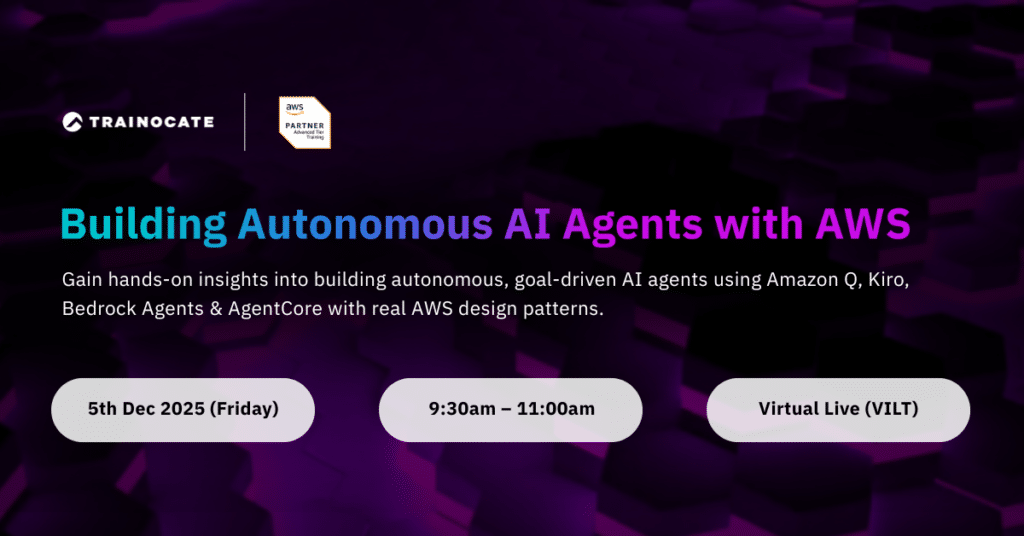
AI agents are redefining how businesses automate, adapt, and make decisions. Join our free virtual event to discover how AWS technologies are shaping the next generation of intelligent, self-directing systems.
- Learn how to design, deploy, and scale autonomous AI agents on AWS
- Explore real-world use cases across industries
- Understand how agentic AI boosts productivity and decision-making
- Gain insights directly from AWS-certified experts