The Ultimate Guide to the Top Data and AI Skills for 2026: Your Roadmap to a Future-Proof Career in Malaysia
The Ultimate Guide to the Top Data and AI Skills for 2026: Your Roadmap to a Future-Proof Career in Malaysia
Introduction: The AI Tipping Point is Here
As we stand on the cusp of 2026, the world of technology is at a pivotal inflection point. The past year has been defined by explosive experimentation with Artificial Intelligence, particularly Generative AI, which has moved from the fringes of tech enthusiasm into the core of enterprise strategy.
Generative AI usage jumped from 55% in 2023 to 75% in 2024, with organizations achieving a return of $3.70 for every $1 invested. AI is expected to contribute $2.7 trillion to Europe’s GDP by 2030, as adoption accelerates, and businesses unlock value in as little as 13 months.
(Source: 6 AI Trends you’ll see more of in 2025)
The initial excitement is now maturing into a pragmatic, urgent demand for tangible value. For professionals and businesses alike, the question is no longer if AI will change your job, but how you can master the skills to lead that transformation.
This shift is profoundly reshaping the global job market, but nowhere is the opportunity more acute than in Malaysia. The nation is on an ambitious, government-backed trajectory to become a regional AI leader through its AI Nation 2030 strategy.
This vision, projected to inject a staggering US$115 billion into Malaysia’s productive capacity by 2030, is being fueled by massive infrastructure investments from tech titans like Google, Microsoft, and Amazon. This top-down push has ignited a firestorm of demand for skilled data and AI professionals.
However, a critical gap has emerged. While a government study found that 70% of new emerging roles are in AI and digital technologies, a separate report from the Malaysia Digital Economy Corporation (MDEC) revealed that only 30% of the current workforce possesses the required digital competencies. This talent chasm creates a golden opportunity for those willing to upskill.
Artificial intelligence (AI) has moved from hype to a central force shaping IT strategy and investment. For the third year in a row, integrating AI took the number one spot on the IT priorities list. One-third (33%) of IT decision-makers cite integrating AI as a top IT priority for the next year (Source: Flexera 2026 IT Priorities Report 2026).
This guide serves as your comprehensive roadmap to navigating this new landscape. We will deconstruct the four essential pillars of Data and AI mastery for 2026, providing a clear blueprint for a future-proof career. This cornerstone article will provide a high-level strategic overview, setting the stage for our deep-dive blog series that will explore each pillar in granular detail.
The Four Pillars of Data & AI Mastery for 2026
The era of the “AI generalist” is over. To thrive in 2026, professionals must build deep, specialized skills while understanding how their role fits into the broader AI ecosystem. The most resilient and in-demand careers will be built upon one or more of the following four pillars:
Why Foundational Data Skills Are More Critical Than Ever for 2026
Despite the headlines being dominated by advanced Generative AI, the single biggest obstacle to its successful implementation is far more fundamental: the quality of an organization’s data.
52% of organizations rate their data foundation’s readiness for gen AI implementation as inadequate.
(Source: AWS 2025 CDO Insights: Scaling Generative AI for Value)
This is echoed by Gartner research, which found that 57% of organizations estimate their data is not “AI-ready”.
This “data readiness gap” is the primary reason why many organizations, despite heavy investment, are struggling to achieve a positive return on their AI initiatives. The most sophisticated AI model is useless if it is fed incomplete, inaccurate, or inaccessible data.
This reality places an immense premium on foundational data analytics and business intelligence skills heading into 2026. These are no longer niche competencies but have become the baseline requirement for any professional working with data. Mastering these skills is the essential first step toward a career in the AI economy.
The non-negotiable foundational skills for 2026 include:

SQL (Structured Query Language)
Universally cited as the lingua franca of data, SQL is the standard for querying and managing data stored in relational databases. It is an absolute prerequisite for nearly every data-related role.

Python for Data Analysis
While R remains relevant, Python has become the dominant programming language for data manipulation, analysis, and scripting, thanks to its simplicity and powerful libraries like Pandas and NumPy.

Data Visualization and Storytelling
The ability to communicate insights is as important as finding them. Proficiency in market-leading tools like Microsoft Power BI and Tableau is essential for creating compelling dashboards and reports that drive business decisions.
To learn how to master these essential skills, stay tuned for our upcoming deep-dive article: The Starting Line: Mastering the Foundational Data Analytics Skills That Get You Hired in 2026.
Specializing in the New Frontier: Core AI & Machine Learning Skills
For those looking to build the intelligence engines of the future, specializing in AI and Machine Learning (ML) offers a path to some of the most exciting and lucrative roles in the tech industry.
Employers expect 39% of key skills required in the job market will change by 2030. This figure represents significant disruption but is down from 44% in 2023 (Source: WEF Future of Jobs Report 2025).
As businesses in Malaysia and globally move to embed AI into their core products and services, the demand for AI/ML specialists is soaring. A government study highlighted that of 60 new emerging job types, a remarkable 70% are in AI and digital technologies, creating hundreds of thousands of new roles.
The required skill set in this domain is advancing rapidly. While a solid understanding of classical machine learning algorithms remains important, the focus for 2026 is on more advanced and specialized areas:
Deep Learning
This subfield of machine learning, which powers the most advanced AI systems, is a critical skill. Expertise in designing, training, and deploying neural networks is paramount.

Natural Language Processing (NLP)
Fueled by the rise of Large Language Models (LLMs) like ChatGPT, NLP has become one of the hottest areas of AI. Skills in building applications that can understand, interpret, and generate human language are in extremely high demand.

Proficiency in AI Frameworks
Hands-on experience with industry-standard deep learning frameworks is a must. TensorFlow and PyTorch are the undisputed leaders in this space, and employers expect candidates to be proficient in at least one.

MLOps (Machine Learning Operations)
As AI moves from the lab to production, MLOps has emerged as a crucial discipline. It combines ML, DevOps, and data engineering to automate and manage the lifecycle of machine learning models, ensuring they are scalable, reliable, and maintainable.
Ready to build the next generation of intelligent systems? Watch for our next article: The Intelligence Layer: Which AI and Machine Learning Skills Will Define 2026?
Building the Future: The Soaring Demand for Data Engineers
If data is the new oil, then data engineers are the architects building the refineries, pipelines, and storage facilities.
This role, while often less visible than that of a data scientist, is arguably one of the most critical and in-demand for 2026. As organizations grapple with the “data readiness gap,” they are realizing that their AI ambitions are entirely dependent on the quality of their underlying data infrastructure.
Data engineers are responsible for designing, building, and maintaining the systems that collect, store, and process vast amounts of data, making it available and accessible for data analysts and machine learning models. Their work is the essential prerequisite for any successful data or AI initiative.
The key technologies and skills defining the data engineering landscape for 2026 are heavily centered on the cloud:

Cloud Platform Expertise
Proficiency in one of the major cloud platforms—Amazon Web Services (AWS), Microsoft Azure, or Google Cloud Platform (GCP) is crucial. Employers are looking for engineers who can build and manage data solutions within these ecosystems.

Modern Data Warehousing and Lakehouses
The data landscape has evolved beyond traditional databases. Expertise in modern cloud data platforms like Snowflake and Databricks is now a highly sought-after skill, as these platforms provide the scalability and flexibility needed for big data and AI workloads.

Big Data Technologies
A strong understanding of the big data ecosystem is crucial. This includes experience with data processing frameworks like Apache Spark and workflow management tools that enable the creation of robust ETL (Extract, Transform, Load) processes.
Discover how to become an architect of the AI era in our upcoming post: Building the Backbone of AI: Why Data Engineering is the Hottest Tech Career of 2026.
Beyond the Code: The New Strategic AI Skill Set for Leaders
The most profound shift driven by AI is not just technological; it is organizational. As we enter 2026, the paradigm is evolving from AI as a passive tool to AI as an active collaborator. This is the dawn of the Agentic Era, where autonomous AI agents can plan, execute multi-step tasks, and work alongside human counterparts.
This transformation demands a new playbook for leaders and managers. Leading in the AI era is less about understanding code and more about understanding capability.
Microsoft’s 2025 Work Trend Index report captures this with the concept of the “agent boss” – A manager who strategically builds, delegates to, and oversees AI agents to amplify their team’s productivity.
This requires a new, non-technical but highly strategic skill set:
Learn how to lead in the new age of AI in our final series installment: The New Leadership Playbook: 4 Strategic AI Skills Every Manager Needs in 2026.
Mapping Your Career: In-Demand Roles and Salaries in Malaysia for 2026
The acute shortage of skilled talent in Malaysia is driving highly competitive compensation for Data and AI roles. Professionals with the right skills can command significant salary premiums and expect rapid career progression. While the overall average monthly salary in Malaysia was around RM5,200 in 2025, data professionals earn substantially more, with some leadership roles reaching up to RM480,000 annually.
Here is a summary of the most in-demand roles and their typical salary ranges in Malaysia as we head into 2026:
| Job Role | Entry-Level Monthly Salary (RM) | Senior/Lead Annual Salary (RM) |
|---|---|---|
| Data Analyst | 3,500 – 5,000 | 120,000 – 200,000 |
| Data Scientist | 5,000 – 8,000 | 220,000 – 480,000+ |
| AI/Machine Learning Engineer | 6,000 – 9,000 | 250,000 – 450,000+ |
| Data Engineer | 5,500 – 8,500 | 240,000 – 400,000+ |
| Business Intelligence (BI) Specialist | 4,000 – 6,000 | 150,000 – 250,000 |
Upcoming Free Virtual Event: Generative AI for Executives
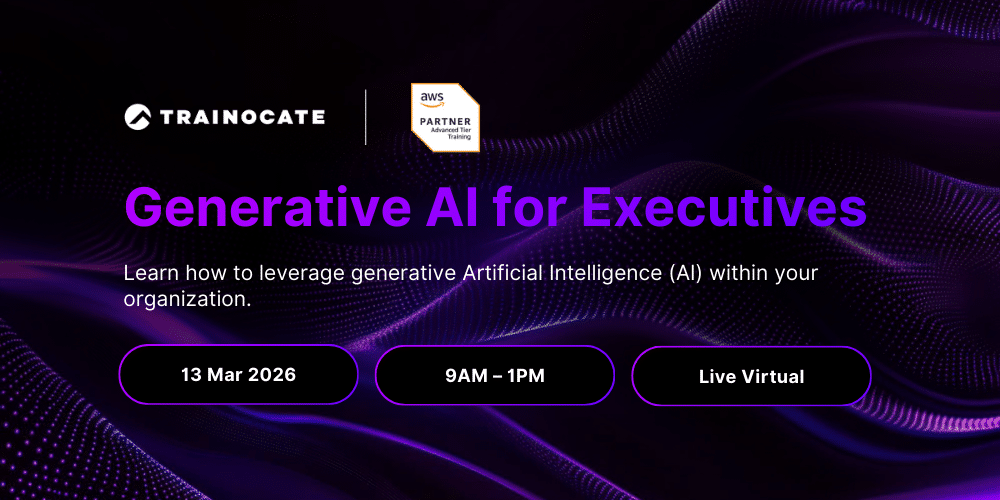
Learn how to leverage generative Artificial Intelligence (AI) within your organization.
This course covers how to drive business value with generative AI, the use cases across various industries, and the considerations to implement generative AI safely and responsibly.
- Recognize the potential business value of generative AI.
- Identify real world use cases that you can implement today.
- Manage the people, process, and technology changes needed to be successful.
- Use generative AI safely and responsibly.
- Identify the specific steps you can take to get started with generative AI.